Camping water filtering and storage: filter, then store it clean
Health note: This guide is general information about treating water outdoors, not medical advice. If anyone in your group develops persistent vomiting, diarrhoea, fever, or signs of dehydration after a trip, seek medical care and mention the water sources used.
Clear water is not a safety test. A stream can look pristine and still carry bacteria, protozoa, or viruses from human or animal waste upstream, and REI's Expert Advice puts the point plainly: there is no easy way to tell whether a clean-looking source is harbouring a microbe, and ingesting as few as 10 disease-causing microorganisms can be enough to produce diarrhoea and other dehydration-inducing symptoms. That is why camping water has three separate jobs, and skipping any one of them undoes the other two. First, choose the best source available. Second, treat the water with a method that actually covers the organisms in question. Third, store the treated water so it stays treated. Most short guides cover the middle job and wave at the other two. This one treats all three as one system.
Filtered is not the same as purified
The most useful distinction in the whole topic is also the one most often blurred. Protozoa such as Cryptosporidium and Giardia have a hard outer cyst that protects them against certain chemicals, but their relatively large size makes them easier to filter out. Bacteria such as E. coli, Salmonella, and Campylobacter are midsize and can also be removed by water filters. Viruses such as hepatitis A, rotavirus, and norovirus are smaller than both, are difficult to filter out, and removing or neutralising them is what “purifying” properly means. A filter and a purifier are therefore not two names for the same thing.
The Centers for Disease Control and Prevention (CDC) backcountry guide states the hierarchy directly: boiling is the most reliable way to kill germs, and if you cannot boil, the next best option is to use a filter — especially if the water is cloudy — and then use another treatment method. The CDC comparison table shows a standard filter as not effective against viruses, while boiling, chlorine, iodine, chlorine dioxide, UV light used in clear water, and a filter combined with a disinfectant are listed as effective against viruses. The same table is a warning in the other direction: chlorine and iodine are not effective against Cryptosporidium, chlorine dioxide is only somewhat effective against it, and a filter certified for cyst and oocyst reduction is effective against both Giardia and Cryptosporidium. No single lightweight method covers everything, which is exactly why the pairing matters.
How much water to plan for
Start with drinking water, then add the camp jobs. Coghlan's camping guidance uses about half a gallon — roughly 2 litres — per person per day for drinking as a general rule of thumb, with additional water needed for cooking, washing dishes, and personal hygiene. Worked as a concrete example: a group of four on a two-night car-camping trip needs about 16 litres just for drinking (2 litres × 4 people × 2 days), before a single pot is filled or toothbrush rinsed. Add cooking and washing-up water on top of that figure, and add more again in hot weather or on hiking-heavy days. At a campground with a reliable potable tap, that math tells you the size of the main storage container to fill on arrival. Away from a tap, it tells you how many filter cycles the group will run each day — and why a method that is pleasant for one bottle can become a chore for sixteen litres. Plan the container and the treatment method together, not separately.
The treatment methods, compared
| Method | Bacteria | Protozoa | Viruses | Watch out for |
|---|---|---|---|---|
| Boiling (1 minute; 3 minutes above 6,500 feet) | Effective | Effective | Effective | Fuel, time, and hot water to cool and store safely |
| Standard hollow-fibre filter | Effective | Effective when certified for cyst reduction | Not effective | Clogging in cloudy water; damage if a wet filter freezes |
| Chlorine or iodine | Effective | Not effective against Cryptosporidium | Effective | Label contact time must be honoured; taste |
| Chlorine dioxide | Effective | Somewhat effective against Cryptosporidium | Effective | Longer contact time; follow the product label |
| UV light | Effective in clear water | Effective in clear water | Effective in clear water | Particles can shield germs; pre-filter cloudy water first |
| Filter, then disinfectant | Effective | Effective | Effective | Two steps, but the combination the CDC points to after boiling |
Comparison summarised from the CDC backcountry water treatment guide, checked 17 October 2026. “Effective” follows the CDC table's own wording; always follow the label of the specific product in hand, including its contact time for disinfectants.
As a spec check on what a typical filter actually promises, consider the Sawyer Squeeze, listed by its manufacturer at $45.99 USD when checked on 17 October 2026. Sawyer rates it at 0.1 micron absolute hollow-fibre filtration and states that it removes 99.99999% of bacteria such as salmonella, cholera, leptospirosis, and E. coli, 99.9999% of protozoa such as giardia and cryptosporidium, and 100% of microplastics. The filter itself is listed at 3 ounces, the kit at 8.19 ounces, and the filter fits standard water bottles with 28 mm threads. Read those numbers carefully: they are strong claims for bacteria and protozoa, and they say nothing about viruses — consistent with the CDC table. A camper who understands that one spec sheet understands the whole category: buy a filter for what it removes, and pair it with a disinfectant or boiling when virus coverage matters.
Step by step: from source to storage bottle
- Pick the clearest source you can reach. Prefer flowing water in a stream or river. If only calm water is available, choose a spot without much sediment or silt, and reach away from the shore where possible, where microorganisms tend to accumulate in higher concentrations. Avoid sources near grazing meadows, pack-animal traffic, or signs of sloppy human use when an alternative exists. After heavy rain, wait before gathering if you can: rising streams carry washed-in surface material and higher bacterial loads.
- Settle or pre-filter cloudy water. Scoop from near the surface of the least murky section, let the pot sit so sediment sinks, and pour off the clearer water without disturbing the bottom. With no dedicated prefilter, strain the water through a bandanna before treating. Sediment impairs every treatment method: it clogs filters, and it can shield germs from chemicals and UV.
- Wash or sanitise your hands before water duty. REI notes that many illnesses blamed on bad water are actually caused by poor hygiene. Sanitise before food preparation, before handling treated water, and after your hands have been in a natural water source.
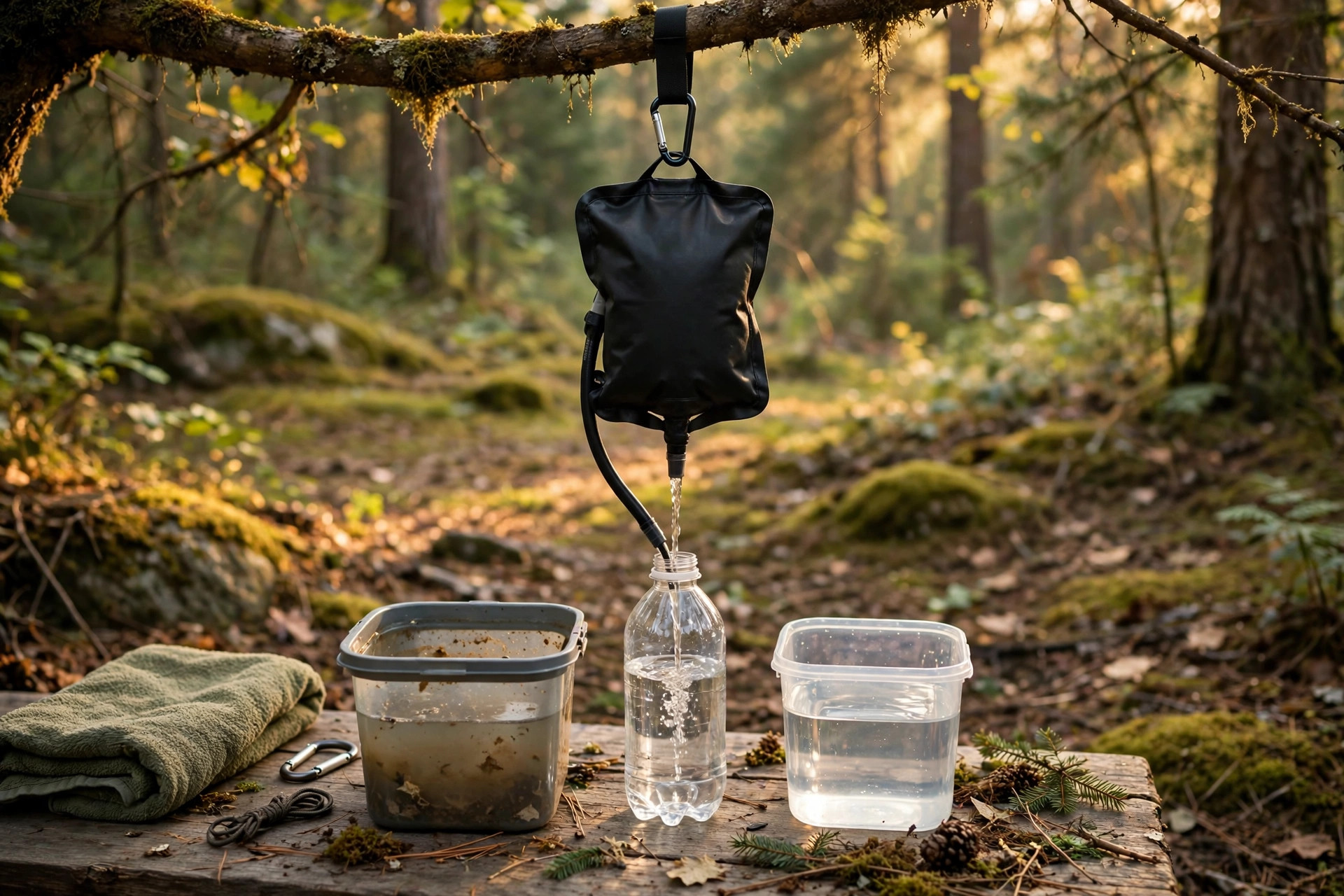
- Filter into a designated clean container only. Keep dirty and clean containers separate and clearly designated, and follow the product's directions closely, because they are written to prevent cross contamination — untreated water entering treated water. Never let the clean-side outlet, cap, or bottle mouth touch source water or the dirty container's rim.
- Close the virus gap when it matters. If the filtered water will be stored, shared with children or anyone with a weaker immune system, or drawn from a busy, low, or questionable source, add the second step the CDC recommends: disinfect the filtered water following the product label's contact time exactly, or boil it — a rolling boil for 1 minute, or 3 minutes above 6,500 feet (about 2,000 metres).
- Store it sealed, labelled, and shaded. Move treated water into the clean storage container, close it, and keep it out of the dirt at the edge of camp. Drink from a cup or a clean bottle rather than passing one bottle mouth to mouth, and rinse cap threads with treated water if they have touched source water.
- Backflush and dry the filter after the trip. The Sawyer kit, for example, includes a cleaning plunger and a cleaning coupling for exactly this job. Restoring flow at home, while the sediment is still fresh, is far easier than reviving a filter that was put away clogged.
What success looks like: every container at camp is unmistakably dirty or clean, the treated water tastes of nothing alarming, the filter still runs at a reasonable flow after backflushing, and nobody has to ask which bottle is safe to drink from. If that last test fails, the system — not the filter — is what needs fixing.
Storing treated water without undoing the work
Storage failures are quiet ones. Treated water is recontaminated by a dirty hand on a cap, a clean bottle filled from the dirty pouch by mistake, or a storage jug left open beside the stove where splash and dust reach it. The defences are boring and complete: separate containers, a lid that stays on, hands sanitised before pouring, and one person on water duty at a time so the dirty-to-clean handoff is never improvised. Keep camp, toilet, and dishwashing activity at least 200 feet from any water source, carry cleaning water away from the source rather than washing at its edge, never toss soapy water directly into a source, and disperse soapy water on soil, where soil microorganisms help metabolise the pollutants. Those Leave No Trace habits protect the next camper's source as well as your own.
Carry a backup treatment method as well. REI's advice is to always carry one: a filter can be lost, batteries can drain, and a device can break, while chemical treatment offers extra security for negligible weight, and boiling works with the stove already in camp. A backup that weighs almost nothing turns a broken filter from a trip-ending problem into a slower evening of boiling and cooling.
Looking after the filter itself
Freezing deserves its own warning. REI's filter guide notes that filters that can freeze and crack can be stored overnight inside a sleeping bag, though that does not help if daytime temperatures also remain below freezing, and that many chemicals lose effectiveness in the cold. A hollow fibre filter that has frozen while wet may keep flowing while no longer filtering as rated — the dangerous kind of failure, because nothing looks wrong. On cold trips, the filter sleeps in the bag, travels in an inside pocket, and, if there is any doubt that it froze wet, it is retired or backed up by boiling and chemicals rather than trusted. Between trips, backflush it, let it dry before storage, and keep the clean-side caps on so the outlet stays the cleanest part of the kit.
FAQ
Is filtered water the same as purified water? No. Filtering removes particles, protozoa, and bacteria. Purifying also removes or neutralises viruses, which are smaller and difficult to filter out. The CDC's recommended combination — filter, then disinfect — is what bridges the two.
Does clear mountain water still need treating? Yes. Water containing bacteria, viruses, and parasites can look clean, and any source an animal can reach can carry the microorganisms animals leave behind. Treat every natural source, including the water used for cooking and brushing teeth unless it will be boiled.
What happens if a water filter freezes? A filter that freezes while wet can crack internally and lose its rated protection while still flowing normally. Protect it from freezing in an inside pocket or a sleeping bag, and do not rely on a filter you believe froze wet — use boiling or chemical backup instead.
How long can treated water be stored at camp? There is no single safe number that applies to every container and temperature, so the practical rule is procedural rather than numerical: store it sealed in a designated clean container, keep hands and caps clean, use the oldest treated water first, and re-treat any water whose container was opened to dirt, source water, or an unwashed hand. When in doubt, boil it — boiling resets the question entirely.