Hammock camping for beginners: your first hang, warm and dry
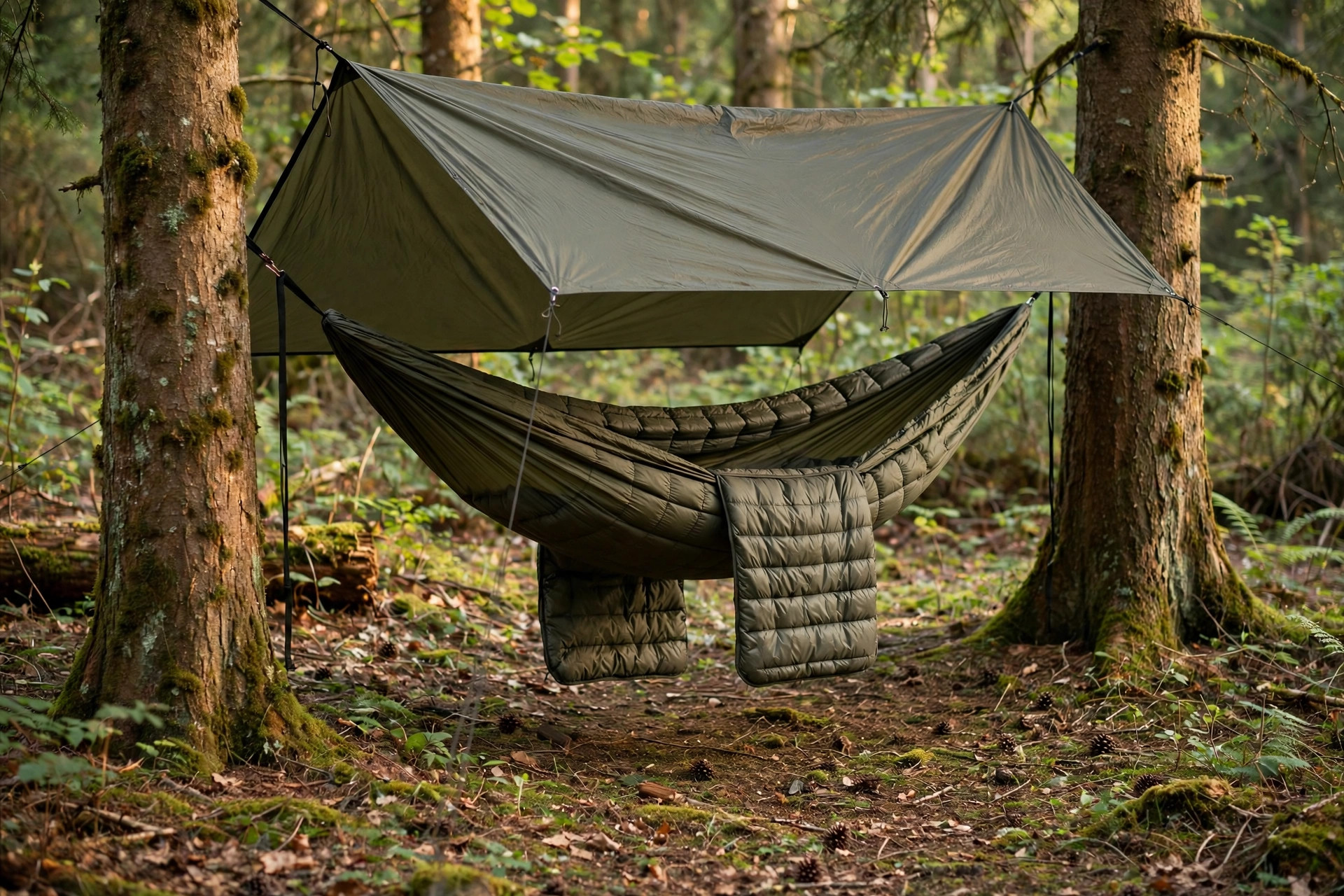
A hammock looks like the simplest shelter in camp: two trees, a sling of fabric, done. The first night teaches the fuller truth. A hammock is a system with four parts that all have to work together — a suspension that holds the right angle, insulation underneath the sleeper as well as on top, a tarp overhead, and a pair of trees the campsite is actually allowed to use that way. Beginners who struggle almost never bought the wrong hammock. They hung it too tight, slept in a curve, froze from below on a mild night, or discovered at dusk that the site had no legal pair of trees. Every one of those failures is preventable in daylight, which is where this guide insists the first hang happens: at home, in a park, or at a campsite close enough to a car that bailing out is an option rather than a crisis.
A hammock is a system, not a hammock
As a concrete spec check, take a common beginner bundle: the ENO DoubleNest hammock with Atlas straps, listed by the manufacturer at $104.90 USD when checked on 17 October 2026. The DoubleNest is rated to 400 lbs (181 kg), measures 9 ft 6 in by 6 ft 4 in (2.9 by 1.92 m), weighs 19 oz (538 g), and is made of 70-denier nylon. The Atlas straps are 9 ft long, taper from 1.5 inches to 0.75 inch in width, weigh 9 oz (255 g), and bring the bundle to 28 oz (793 g) in total. Two lessons hide in those numbers. First, the straps are sold as part of the system for a reason: a hammock without a proper wide-strap suspension is incomplete, not cheaper. Second, even that bundle contains no tarp and no bottom insulation, so the purchase price of the hammock itself is never the price of sleeping in one. Budget and pack for the whole system — hammock, straps, insulation below, cover above, and bug protection in season — or the first cold, wet, or buggy night will itemise the omissions.
Before you hang: permission, trees, and ground rules
Leave No Trace publishes hammock-specific guidance, and it starts before any strap touches bark. Check with local land managers that hammocking is allowed at all: some state and local parks prohibit hanging hammocks, and discovering that from a ranger at sunset is the worst version of the news. Use “tree saver” straps of webbing 0.75 to 1.5 inches wide, which spread the load and minimise girdling and damage to the bark and the cambium layer beneath it; never use anything thinner than 0.75 inch, and never hammer or screw anything into a tree. Choose live, sturdy trees and look up before committing: do not hang from dead trees, and check the canopy above for dead branches that could fall. Set up at least 200 feet from any water source to protect the riparian zone, prefer an established campsite over a fresh one — good campsites are found, not made — and keep the lowest point of the occupied hammock no more than 18 inches off the ground, hanging from the thickest part of the trunk and avoiding trees that bend or stand in wet ground. Take the hammock down whenever you leave the campsite, so animals or children cannot become tangled in it. None of this is decoration. The strap width protects the tree, the height limit protects the sleeper, and the permission check protects the trip.
Step by step: your first hang, in daylight
- Choose the pair of trees. Look for two healthy, live trees at least about 6 inches in diameter, spaced roughly 12 to 15 feet apart for a first hang — close enough that standard straps reach, far enough that the hammock can sag properly. Check overhead for dead branches, check the ground between them for roots, nests, and delicate plants to avoid, and confirm the spot sits at least 200 feet from water.
- Wrap the straps at about head height. Put the straps around the thickest part of each trunk, roughly 5 to 6 feet above the ground, with the flat webbing against the bark. Anchor points in that 4-to-6-foot range are what make the geometry in the next step possible.
- Hang loose, at about 30 degrees. Connect the hammock and adjust until the suspension runs at roughly a 30-degree angle from horizontal. A hammock pulled drum-tight feels reassuringly firm and sleeps badly: the fabric wraps around the shoulders and forces a curved, banana-shaped lie. The sag is the comfort, not a defect to be tightened away.
- Run the sit test. Sit in the middle of the hammock as if it were a chair, feet on the ground, and shift your weight. The lowest point should sit at about chair height and no more than 18 inches off the ground. Too high means moving the straps or choosing a longer span; too low means shortening the suspension. Never hang higher than you are willing to fall.
- Lie diagonally, not straight. Swing your legs in, then angle your body across the hammock — head to one side of the centreline, feet to the other. On the diagonal, the fabric flattens beneath you and the curved banana lie largely disappears. Straighten the setup, re-check the 30-degree angle, and adjust until the diagonal lie feels flat rather than folded.
- Add bottom insulation before dark, not after midnight. Hang the underquilt snugly beneath the hammock, or place the pad inside it, and then lie in the hammock again to check for gaps at the shoulders and feet. Insulation fitted while you can see it stays fitted; insulation improvised at 2 a.m. does not.
- Pitch the tarp above, with drip lines. String the tarp on its own ridgeline above the hammock so both ends of the hammock sit well inside its cover, tension it so water cannot pool, and tie short drip lines on the suspension so rain running down the straps drips off before it reaches the hammock fabric. Lower the tarp and close its ends down when wind-driven rain is expected.
What success looks like: you can sit down into the hammock without climbing, lie diagonally with a reasonably flat back, feel insulation in contact beneath your shoulders and feet with no cold gap, and see tarp cover extending past both ends of the hammock. If any one of those four checks fails in daylight, fix it then. Each one is a five-minute adjustment at 4 p.m. and a miserable hour at night.
Why hammocks feel cold, and the two fixes
The classic beginner report — a mild night, a warm-rated sleeping bag, and a sleeper who froze anyway — has a mechanical explanation. In a tent, the sleeping pad underneath is the insulation and the bag's loft works on top. In a hammock, body weight compresses the sleeping bag's insulation directly beneath the sleeper; compressed loft loses the trapped air that does the insulating, while cool air circulates freely under the thin hammock fabric. The result is a cold back, shoulders, and feet even when the top of the bag feels warm. The fix is insulation that is not compressed, and there are two standard ways to get it.
| Bottom insulation | How it works | Strengths | Trade-offs |
|---|---|---|---|
| Underquilt | A quilt hung beneath the hammock, loft uncompressed | Insulates shoulders to feet without shifting; the purpose-built option | Another piece of gear to buy and pack; must be hung snug to avoid cold gaps |
| Sleeping pad inside the hammock | The pad you already own, placed between sleeper and fabric | No new purchase; doubles as a go-to-ground backup | Can shift and curl at the edges; narrower coverage at shoulders and feet |
| Sleeping bag alone | Loft compressed under body weight | Nothing extra to carry | The compressed underside loses insulation exactly where air circulates — the cold-bottom problem itself |
Beginner guidance commonly suggests adding an underquilt or an insulated pad once nights drop below about 65°F, and the honest summary is simpler: if the night would feel cool in a tent, a hammock without bottom insulation will feel colder. Starting with the pad already in the gear closet is a reasonable first trip. Upgrading to an underquilt is the step most hammock campers eventually take for shoulder-to-foot coverage that stays put through the night.
Rain, bugs, and water running down the straps
Weather protection in a hammock is a tarp skill, not a hammock feature. The tarp needs to extend past both ends of the hammock, be tensioned so rain sheds instead of pooling, and sit lower and closer when wind drives rain sideways. The detail beginners miss is the suspension itself: in steady rain, water travels along the straps toward the lowest point, which is the hammock. A drip line — a short loop of cord tied on each strap just outside the tarp's edge — interrupts that path and drops the water to the ground. In bug season, a net that encloses the hammock completes the system; in still, hot weather it is also the layer that makes sleeping possible at all in mosquito country. Practise the full pitch — straps, hammock, insulation, tarp, drip lines, net — as one sequence, because in real weather they go up together, in whatever order keeps the sleeper and the bedding driest.
Should you switch from a tent? A simple decision check
Hammocks reward some trips and punish others, and the honest decision can be made with four questions. Trees: does the destination reliably offer legal, sturdy pairs of trees — forested campsites yes, alpine, desert, and many organised campgrounds with assigned pads not necessarily. Ground: is the available ground sloped, rocky, wet, or root-covered? A hammock ignores all of that, which is its single greatest advantage. People: is this a solo sleeper per hammock? Two people share a tent far more comfortably than a hammock, whatever the capacity rating says. System weight and bulk: compare complete systems, not headlines — hammock plus straps plus underquilt plus tarp against tent plus pad. If the answers favour trees, rough ground, and solo sleeping, a hammock is a genuine upgrade. If the trip is a family campground stay on a flat pad, the tent was never the problem.
FAQ
Is hammock camping colder than tent camping? It feels colder without bottom insulation, because the sleeping bag is compressed underneath the sleeper while air circulates below the fabric. With an underquilt or a pad restoring that lost insulation, a hammock sleeps at comparable warmth to a tent using the same top insulation.
How high should a hammock hang? Leave No Trace recommends no more than 18 inches off the ground at the lowest point. Chair height is the practical target: easy to sit into, easy to get out of, and a short distance if anything ever lets go.
Can hammocks be hung anywhere with trees? No. Some parks prohibit hammocks entirely, others restrict how they may be attached, and private campgrounds set their own rules. Check with the land manager or campground first, use wide tree-saver straps everywhere, and treat a “no hammocks” rule as final for that site.
Why not just pull the hammock really tight? A tight hammock wraps the fabric around the sleeper and forces a curved lie. The roughly 30-degree suspension angle and the resulting sag are what allow the diagonal, flatter sleeping position that makes a full night comfortable.